WB088: JLPT Showtime!
On July 5th (Sunday), I will sit for the N2 level of the Japanese Language Proficiency Test ("JLPT"). This test is administrated by the Japan Foundation.
The test paper is divided into three sections: (1) Language Knowledge (Vocabulary & Grammar) (2) Reading Comprehension and (3) Listening.

To pass the test, you need to score at least 19/60 points in each of the sections and a cumulative score of 90/180 points. These requirements ensure candidates give all three sections a fair go.
In Japan, the JLPT is the most widely-accepted measure of Japanese language proficiency for non-Japanese residents.
Job advertisements posted by companies operating in Japan - whether it's a domestic company or a foreign MNC - often have a "N2 level or higher" requirement.
Meanwhile, the Immigration Services Agency of Japan requires Permanent Residency applicants to have at least an N2-level in the JLPT.
I do not think language is intentionally being used as a discriminatory barrier to deter foreign residents. Rather, as society fundamentally operates on smooth communication, language proficiency is key.
Data, data, data
I recently discovered that the Japan Foundation publishes historical statistics on the JLPT. There are two seatings held each year, one in July and one in December.
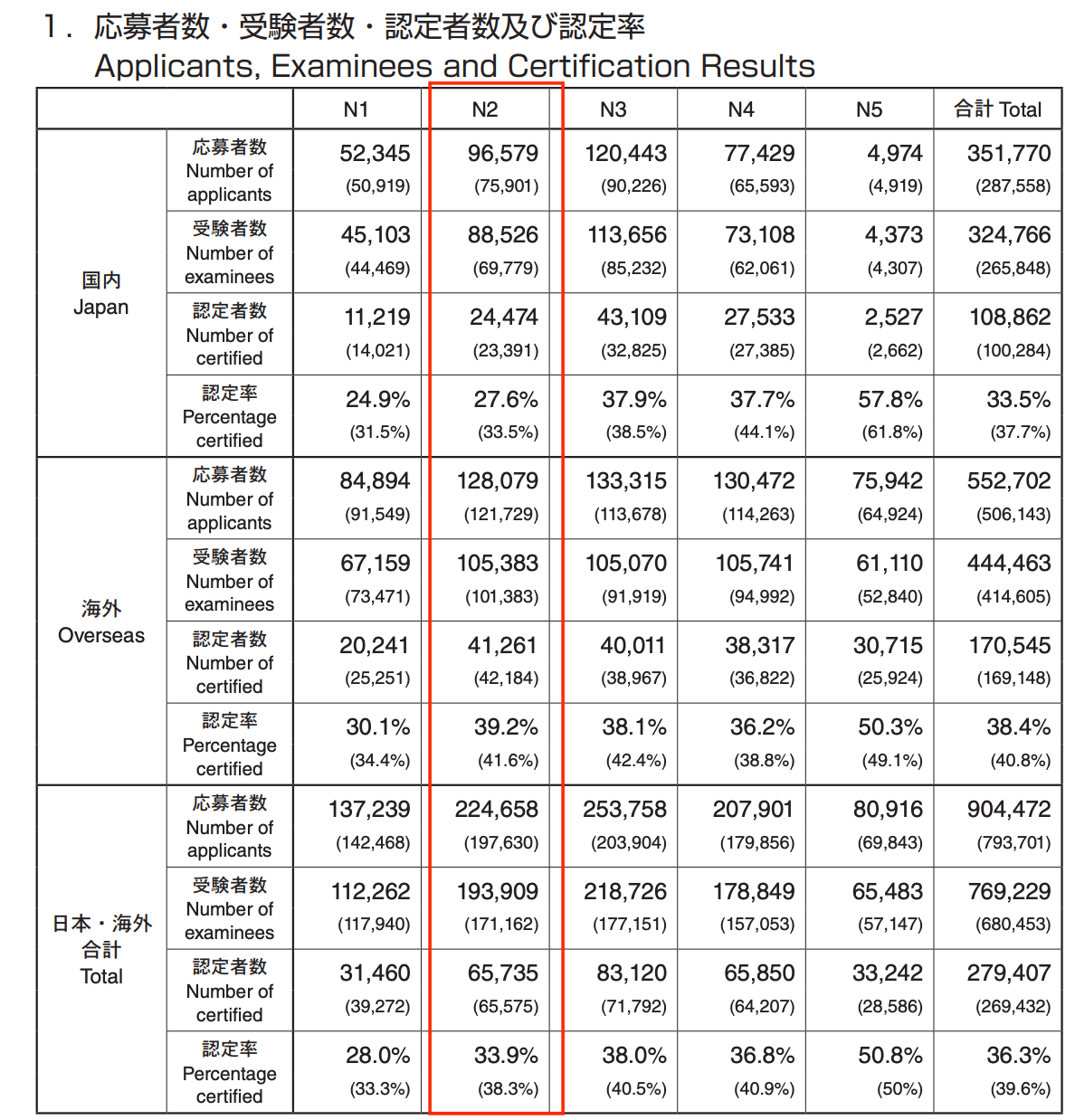
In the July 2025 sitting, across all levels there were a total of 769,229 candidates, of which 444,463 (57.7%) were overseas candidates while 324,766 (42.3%) were local candidates.

Across the two sittings in 2024, a total of 1,470,989 candidates across all levels sat for the JLPT, material 147% increase from the 594,682 candidates in 2014. This suggests an increase in popularity for the Japanese language.
Zooming in to the the N2-level statistics, the passing rate was 33.9% in the July 2025 sitting. In other words, only one in three candidates passed.
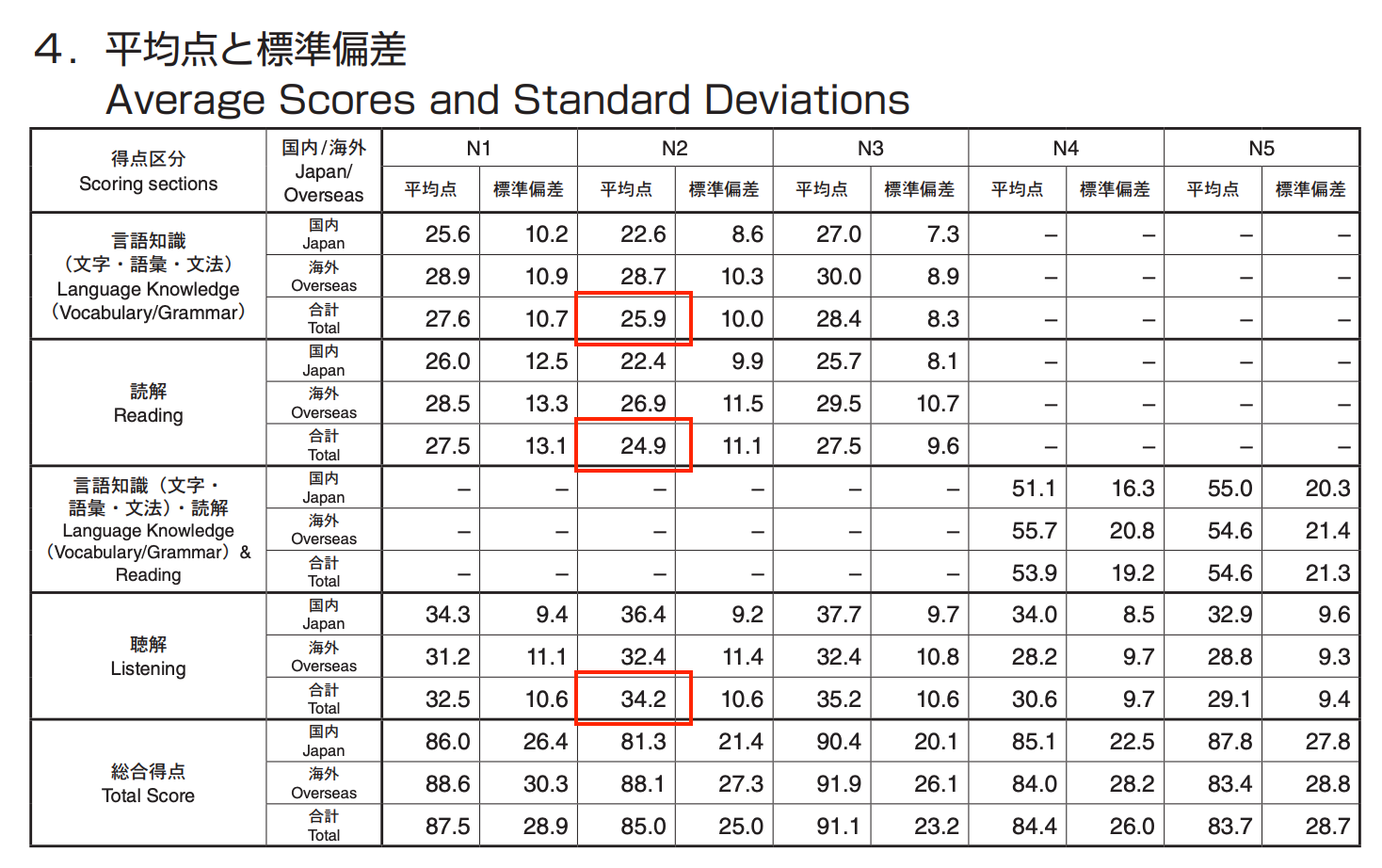
And diving a little deeper, it is interesting to note that candidates fared better in the Listening section compared to Language Knowledge and Reading Comprehension.
I think this makes a whole lot of sense, as most people learn language by ear. Meanwhile, learning to read in any language is often a more taxing and time-consuming skill to hone, especially with a language like Japanese that has three different sets of characters - hiragana, katakana and kanji.
Anyway, the point of my looking at these statistics is not to do a full-blown analysis to strategise the most efficient and painless way to pass the JLPT. At the end of the day, I believe you'd be doing yourself a great disservice by going down this route.
What is this all for?
A certification is more than just a resume-filler and score. It is about the knowledge you acquire in the process that you can actively apply to other aspects of your life.
Owing to my JLPT journey, I can now read more intermediate Japanese books & comics, along with conversing with on a slightly deeper level. What were once steep, uphill battles have slowly but surely become smoother, albeit still challenging, journeys.
To be clear, these outcomes have not been immediate, are difficult to measure and take a lot of time to manifest. These are hardly selling points in today's world, where we are obsessed with speed, efficiency, and an expectation of positive outcomes just because we put in the effort.
There are times when I ask myself what this is all for. After a few minutes of grumbling and complaining, I remind myself that these feelings are borne out of the frustrations of encountering difficult-to-grasp concepts.
These feelings are part of any learning journey. On the bright side, there is also the feeling of satisfaction, as "Aha!" moments arise when the concepts I study appear in an article or announcement.
In life, you don't lose anything important by properly learning a skill or language. On the contrary, you have everything to lose by stopping the journey of learning.
--Ends