WB099: How does maternity leave work in Japan?
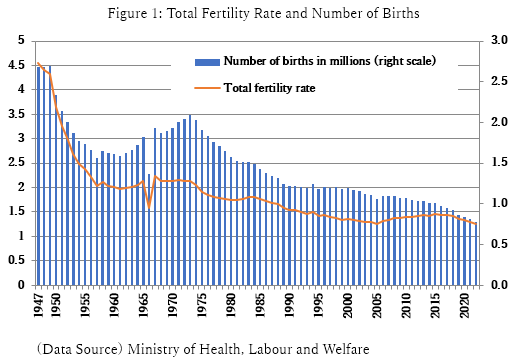
The Total Fertility Rate ("TFR"), measured as children per woman, is the average number of children a woman is expected to produce during her reproductive years if she experiences the age-specific fertility rate and is alive throughout this period.
Globally, a TFR of 2.1 is accepted as the replacement-level fertility. This is what a population needs to replace itself with the next generation or face demographic collapse.
Japan's TFR has been below 2.1 since 1974, with the country's policymakers struggling to boost this rate. Making matters worse is Japan's rapidly-aging population, where nearly one in three people is aged 65 years and older.
Like many countries around the world, there are a variety of measures that seek to alleviate the burden of having children. The hope is that people will be encouraged to procreate.
One such measure is maternity leave, known as sanzensango kyuuka (Japanese: 産前産後休暇).
The purpose of this leave is to give a new mother sufficient time to physically recover, bond with her child and have peace of mind that her job is safe. Without this leave system, I feel it is unreasonable to expect a working woman to give up her career just to have a child.
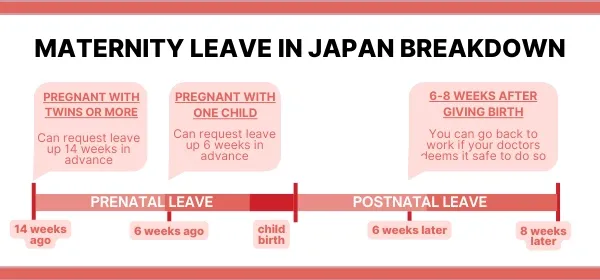
In Japan, maternity leave is 14 weeks long - six weeks' before and eight weeks' after a baby is born. I believe the length of pre-delivery leave is up to the expectant mother, while the post-delivery leave is mandatory by law.
In Japan, provided you are a worker who contributes to the Employees' Healthcare Insurance ("EHI") system called shakai hoken (Japanese: 社会保険), you are entitled to a tax-exempt maternity allowance called shuusann teatekin (Japanese: 出産手当て金).
This allowance works out to around two-thirds (or around 67%) of a mother's monthly wage. For example, if your monthly salary is JPY450,000, you will be given an allowance of JPY300,000.
To further alleviate the monetary burden, a new mother is also exempt from making contributions to the National Pension System and the EHI during maternity leave.
The EHI also gives enrolled mothers a lump sum Childcare and Childbirth Grant of JPY500,000 (~US$3,170) to alleviate the costs of delivering a baby. I think the combined cost of delivery and being warded in the hospital is around JPY800,000, so the Grant is quite helpful.
After maternity leave ends and until a baby turns one, a mother enters the General Childcare Leave period called ikuji kyuugiyou (Japanese: 育児休業). Mothers are entitled to 67% of their full-time wage for the first six months of this leave period, after which the allowance drops to 50%.
Again, pension, insurance and tax obligations are waived.
All in, I think Japan's maternity and childcare leave systems provide good support to mothers. These systems are crucial pillars in encouraging more Japanese households to have children.
The maternity leave allowances may appear generous to those who do not live in Japan. However, bear in mind that as a long-term resident or citizen, you have already paid for these benefits in the form of mandatory insurance premiums.
In the long run, measures like maternity leave and allowances go some way to supporting those who want children. That being said, I doubt the TFR needle will move significantly.
After all, there are more pressing factors in Japan holding people back from having children, such as cost of living pressures due to the weak Japanese yen and high inflation rates, along with Japan's work-hard-at-all-costs corporate culture. Many of the younger generation are also content to live in the present moment and enjoy life.
--Ends