WB003: Establishing my residence in Japan
I moved to Japan recently and had to properly establish my residence in the Ward I live in.
The first step was to pickup my Residence Card (Japanese: 在留カード | Zairyu Ka-do).
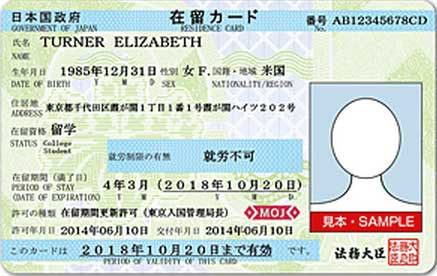
What is the Zairyu Card?
The Zairyu Card is issued to persons who reside in Japan for the mid- to long-term. The Card “certifies” an individual is lawfully residing in Japan.
The Zairyu Card is a legally-recognised means of identifying oneself, and contains important details, such as Name, Date of Birth, Visa Status and Address.
I'd say this card has similar importance to Singapore’s National Registration Identity Card and Malaysia’s MyKad. Living long-term in these countries without these cards are next to impossible.
Where is the card issued?
You are eligible for a Zairyu Card after you receive a valid, long-term Japanese pass (Japanese: 長期滞在ビザ).
The card is issued on the spot1 at major Japanese airports, such as Haneda and Narita Airport.
Simply inform the Immigration staff (at the counter) that you need to pickup your card ("在留カードを受け取ってください") and they'll take it from there. You do not need to fill in any forms nor pay any fees.
When your card is issued, you will notice the blank address (Japanese: 住所地) field at the back of the card.
Don’t panic, as you've now "unlocked" the next step: You have 14 days to register your residential address at your ward’s (Japanese: 区 | ku) General Branch Office (Japanese: 総合支所) or Branch Office (Japanese: 出張所).
This is called the “Resident Registration for Foreigners” (Japanese: 外国人の住所登録) process, according to my Ward's informational guide.
I live in Setagaya-ku (Japanese: 世田谷区) and decided to process my application at the ward’s General Branch Office (Japanese: 世田谷総合支所). The train stop closest to this government building is Shoin Jinja Mae (Japanese: 松陰神社前 ).
Registering your address
Have you met anyone who loves submitting applications to government agencies?
I haven’t.
You are, after all, entrusting the success of an important application to an unknown entity.
This adult rite of passage sometimes feels like a game of Snakes and Ladders: depending on your luck and completeness of your application, you run the risk of falling back to square one or being rewarded with your desired result.
Despite my lack of fluent Japanese, I decided to attempt the submission myself. A couple of reasons why:
- I saw this as an opportunity to experience how well the Japanese civil service handles non-Japanese speaking individuals.
- I wanted to converse using my Japanese
- I wanted to unlock a non-touristy experience
I referred to Setagaya-ku's informational guide (available in various languages) to better prepare myself.
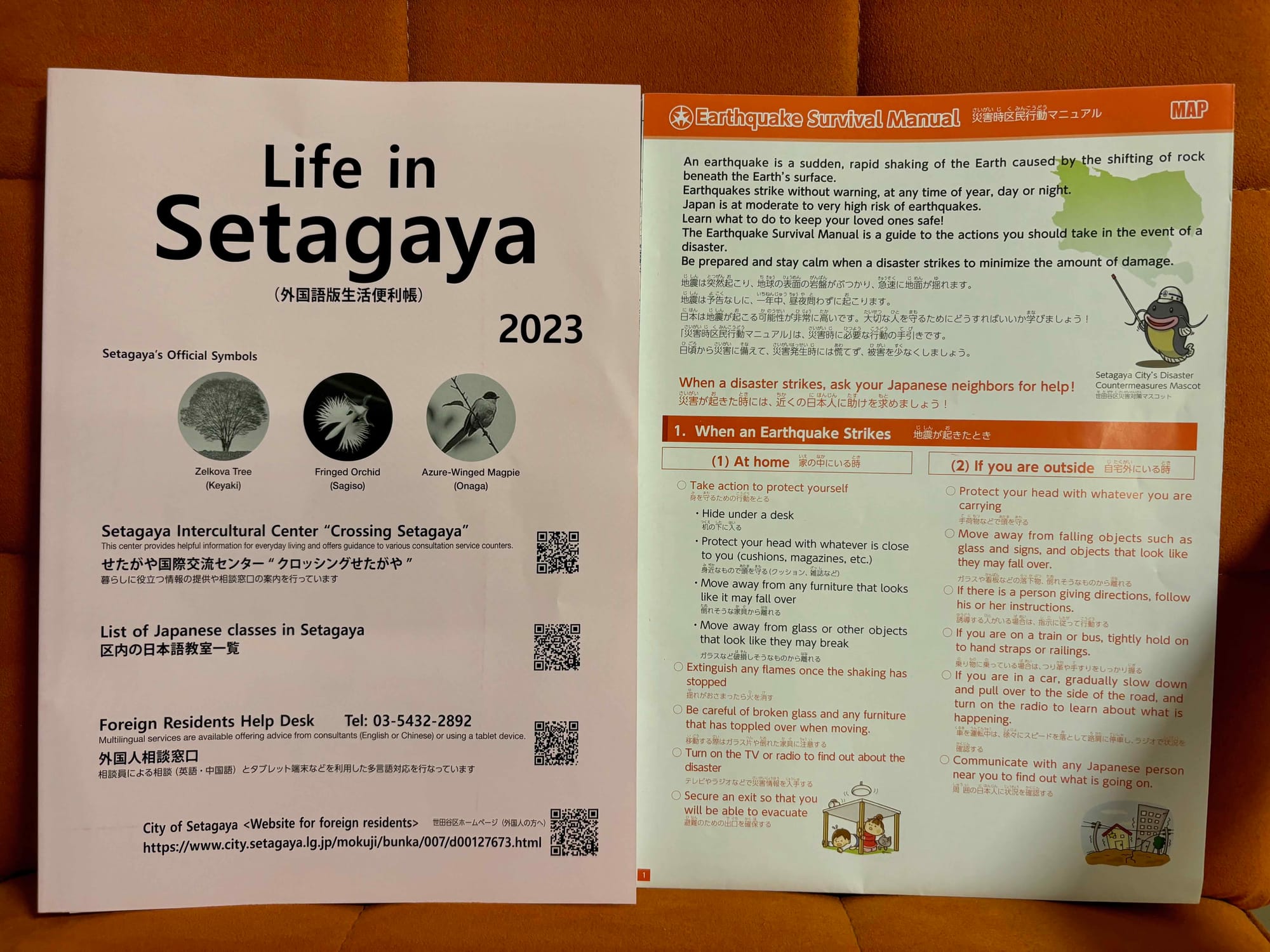
With a little friction here and there – due to the language barrier – I left 世田谷総合支所 with A) My address printer on my Zairyu Card and B) Some informational booklets including "Life in Setagaya 2023" and "Earthquake Survival Manual".
My takeaway
The process of picking up my Zairyu Card and updating my address was better than I expected.
I could feel the Setagaya Ward's staff's kind intentions to help me achieve my objective, despite my lack of Japanese. One could argue that Japan can do better to improve their non-Japanese language capabilities.
This may be true (to a certain extent), but I beg to differ: when you're in Rome, first try to do as the Romans do. And if this fails, then it's probably not your fault.
I also found the staff helpful to the extent that what you're asking is within their domain of expertise. Anything outside, and they'd politely tell you they don't know. On balance, all the answers you need are somewhere in the many informational booklets you receive.
--Ends
1 The pickup counter is the same passport counter you enter as a tourist. I felt this level of detail was missing from the official FAQs, forums and helpline.
2 More on these documents in a future post