WB035: Heart-Warming Oden
The cold winter months are a great time to enjoy a hearty & warm dish that is yummy in the tummy, such as oden (Japanese: おでん).
Oden is a nabemono (Japanese: 鍋物, English: one-pot dish) containing a variety of ingredients cooked in a soy-based dashi (Japanese:出汁) broth. Here are some commonly-found ingredients:
- Hard-boiled egg
- Daikon (Japanese: 大根 ): Winter radish
- Konnyaku (Japanese: こんにゃく): A jelly block made from the bulb of the konjac plant
- Chikuwa (Japanese: ちくわ): Tube-shaped fish paste cake
- Ganmo (Japanese: がんも): Deep-fried tofu mixed with thinly-sliced vegetables
- Mochi Kinchaku (Japanese: 餅巾着): Japanese rice cake in a tofu pouch
Oden is widely available in Japanese izakayas (Japanese: 居酒屋) and convenience stores like 7-11, which even has a webpage on its oden offerings.
For a more economical option, you can make your own oden at home by buying oden sets from a supermarket. These cost around JPY600 - JPY700 for a two-person serving and contain broth concentrate and around 18 pieces of ingredients. Daikon and hard-boiled eggs are usually excluded, unless you're buying a pre-cooked set.
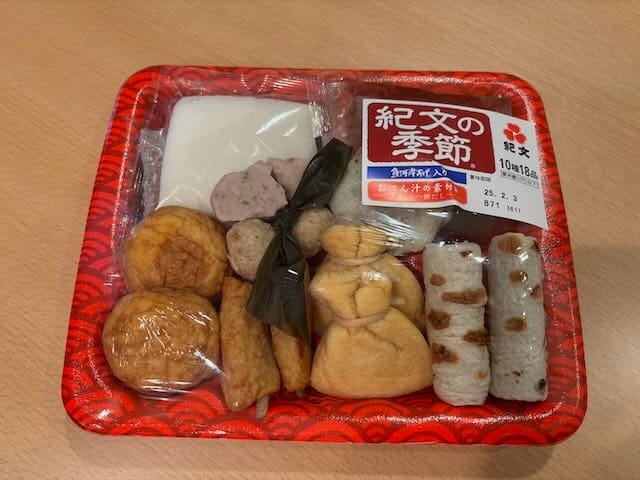
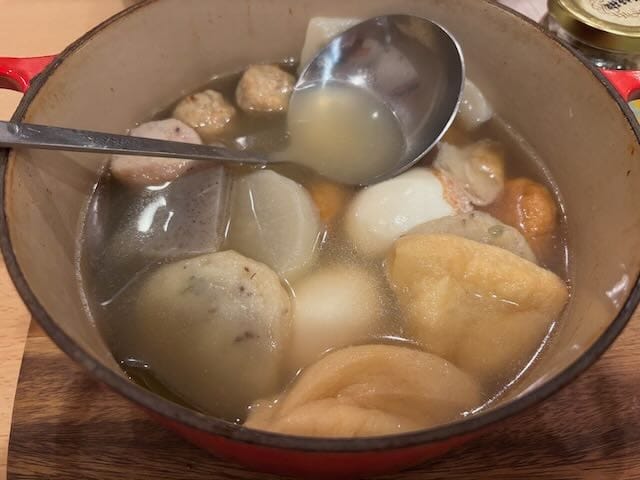
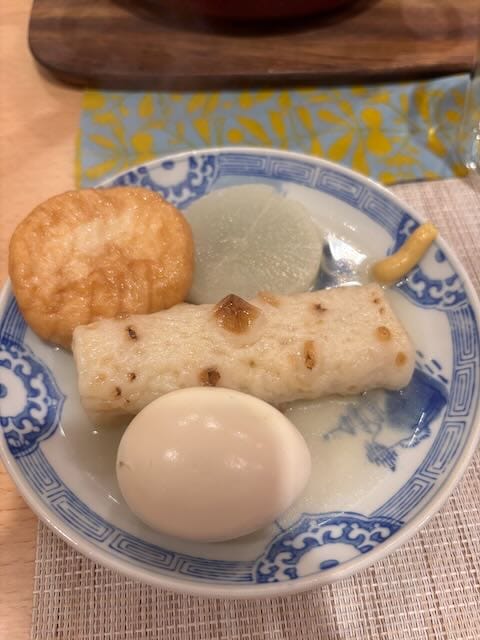
Pre-packaged oden from the supermarket (L) and the final product (R)
Oden is relatively simple to cook. Like any broth- or stew-type dish, the longer the ingredients are soaked, the better they taste.
So what I do is cook my oden in the morning and leave it in the pot so the ingredients can soak up the broth's flavour. When it's dinner time, the oden is reheated and best enjoyed with mustard or wasabi (Japanese: わさび) paste and a bowl of rice.
Apart from having good ingredients and broth, what makes a good oden?
In my view, it is how well the daikon is cooked.
Given daikon is a firm and crunchy root, a good oden daikon has to be soft and full of the broth's flavour. One way to gauge this is by looking at the colour of the daikon: if it is a translucent off-white or dark brown, you're on the right track.
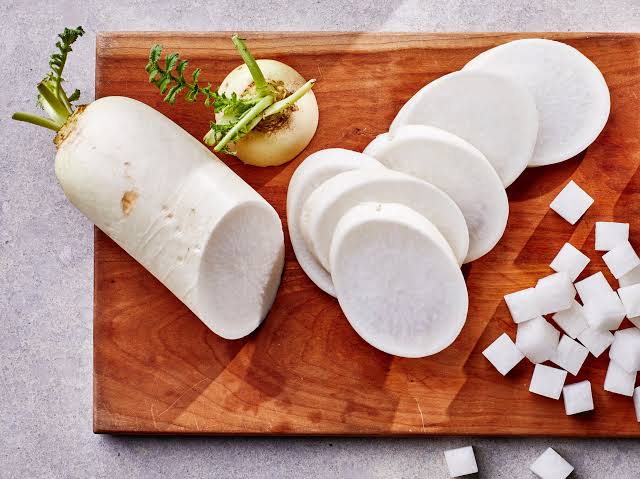
I use the following method to prepare my daikon:
- Cut the daikon into 1.5cm thick slices
- On both surfaces of each slice, cut a cross-shaped slit. This helps the daikon absorb the broth
- Soak the daikon for 10 minutes in cold water
- Drain the water and boil the daikon for 10 minutes in salted water
- Drain the water and cook the daikon with the other oden ingredients. Be sure to place the daikon below all the other ingredients
Izakaya's typically keep their oden on a continuous low boil. As a result, the oden ingredients become a "flavour bomb". The daikon is even a brown colour, something which is not that easy to achieve at home.
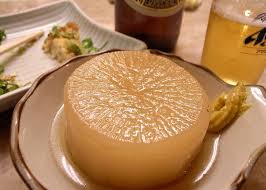

(L) Ultimate oden daikon! (R) Oden setup in a restaurant. Source: Google
--Ends