WB040: Getting a Japanese Driver's License (Part 1)

Many popular tourist destinations in Japan can be conveniently reached via the country's expansive train and bus networks. That said, travelling via car greatly expands one's travel opportunities. You can travel at your own pace and explore places off the beaten track.
Long-term residents of Japan need a locally-issued driver's license. The issuance is handled by the National Police Agency. There are two ways to get a license:
Option A: Get a license from scratch by going to a driving school and passing the requisite written & practical exams (in Japanese).
Option B: Convert a foreign driver's license to a Japanese license via the gaimen kirikae (Japanese: 外面切替, English: foreign license conversion) process.
I opted for Option B, which seemed more straightforward. Plus, who doesn't love checklists and compiling documents?
What is the gaimen kirikae?
This application lets you convert foreign-issued driver's license to a Japanese driver's license.
The conversion must be done in the city you live in. In Tokyo, the application is made to the Metropolitan Police Department (Japanese: 警視庁). The application fee is JPY2,500 (~US$17.60), which is not unreasonable.
The process is straightforward. You first make an application with a pre-defined checklist of documents and do these tests:
- Eye test: Assess your vision & colour recognition
- Knowledge Test: A 10-question true/false test
- Driving Skills Test: Drive while being assessed by an examiner, who is a police officer
You're exempted from (2) and (3) if you are from a list of 29 countries, such as the UK, Switzerland, Germany and the US (certain states). I have to do the full works as the Malaysian license is not exempted.
I have since learned the license conversion is much more than fulfilling a checklist. In fact, it feels like a game of Snakes and Ladders - regressing is just as easy as progressing.
Preparing the documents
The keishicho does a good job explaining (in great detail and in multiple languages) what documents are needed. An incomplete and/or inaccurate set of documents results in rejection.
According to some online forums, there's no wiggle room for negotiations or pleading. Some find this harsh and symptomatic of the Japanese being fixed in their ways.
However, I think otherwise: these requirements are put in place to weed out potential bad actors. It's also a matter of choice whether one chooses to comply or complain. The latter gets you nowhere.
Document 1: Valid foreign driver's license (original) showing the first issuance date
I learned that the Malaysian driver's license does not display the date you were first issued a license (not to be confused with the current license's issuance date).
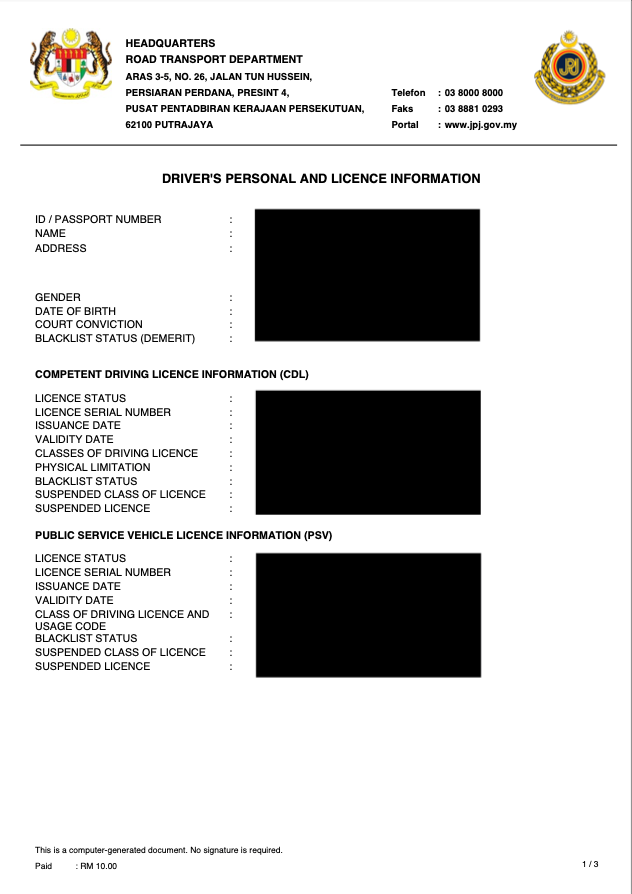
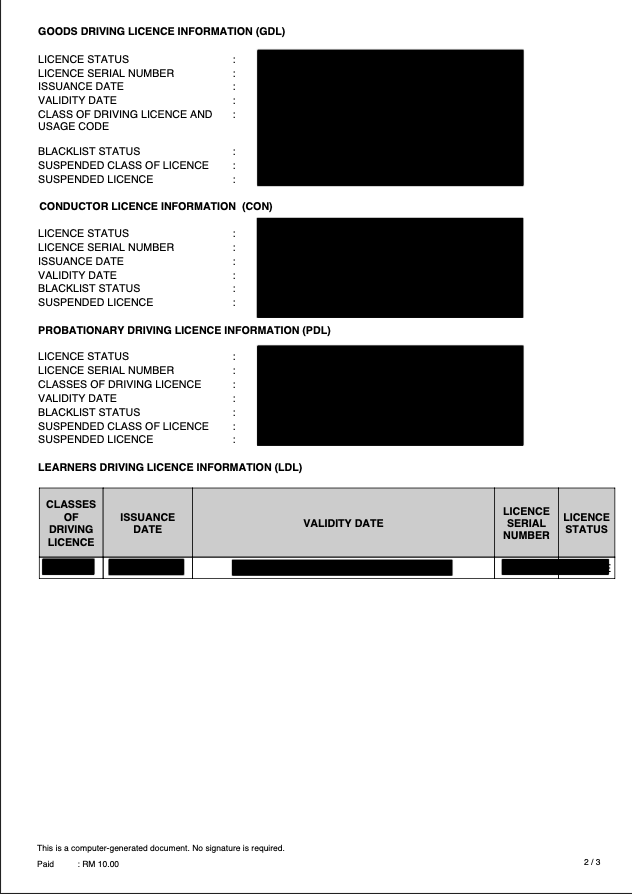
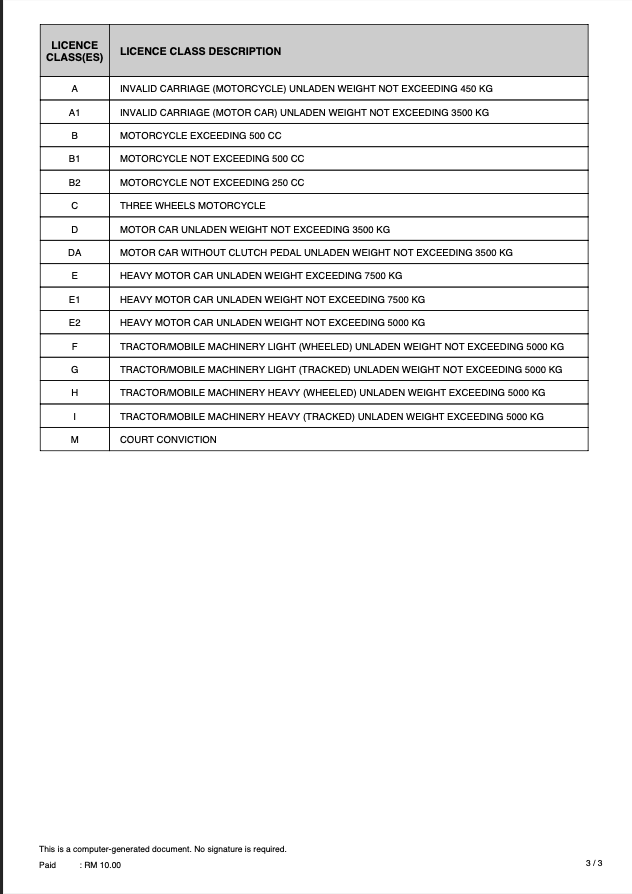
To fulfil this requirement, a document called Driver's Personal & License Information can be purchased from the Road Transport Department's mySikap portal. It costs RM10.00.
Document 2: Japanese translation of license
The keishicho accepts translations from the Japan Automobile Federation (JPY4,000) or the embassy of the country that issued the license.
I learned that the Malaysian Embassy in Tokyo helps Japan-based Malaysians translate licenses for the gaien kirikae (RM20.00). In fact, this is one of many service offerings provided by the Embassy, which I have found to be very professional and efficient.
Document 3: Certificate of Residence or "Juminyo" (Japanese: 住民票)
This can be conveniently purchased from a 7-11 convenience store by using your MyNumber card. The keishicho specifically requests you to redact the MyNumber number printed in the juminyo.
Document 4: Passport - current and past (original)
Expired passports are needed as a supporting document for Document 5. Although I only had one of my past passports, this was acceptable to the keishicho.
Document 5: Document proving you spent more than 90 days in the country of license issuance
At first glance, this is a strange requirement. You fulfil it by showing all the Entry/Exit records from either your passport (the immigration stamps) or a document issued by your country's immigration department.
I learned that this requirement was introduced to close a loophole where bad actors bypassed the strict process of getting a license from scratch by first getting their license overseas and then doing a conversion.
Given physical Entry/Exit stamps are rarely used these days, I needed a document issued by Jabatan Imigresen Malaysia.
Again, the Malaysian Embassy offers this as a service (free). All you need to do is write a request (in Malay) to the Director General of Immigration. The turnaround time of three working days was surprisingly quick.
Document 6: Photograph
This must be in 3cm x 2.4cm dimensions. It can be done in the many self-service photo booths available throughout Tokyo.
Document 7: List of duration of stay in country of license issuance
Based on the Entry/Exit records in Document 5, you fill out a table with all the entry and exit dates to calculate the duration. This process is tedious, but needs to be done. I believe if you can make the assessor's life easier, they will be easier on you.
Once all your documents are compiled (and checked), you're all set to submit them!
Document submission at Samezu driving centre
Before March this year, document submission at Samezu Driver's License Testing & Issuance Centre (Japanese: 鮫洲運転免許試験場) was a major hurdle for applicants due to the limited daily application slots.
Compounding the problem was the lack of a booking system, the sheer volume of foreigners converting their licenses and the centre being open on weekdays only.
I read stories of applicants coming as early as 6am (for the 8am opening), only to be turned away. This made gaien kirikae a very painful process, especially for working folks.
Fortunately, the newly-introduced online booking platform offers certainty and smoothens the process. There are, however, long waiting times for available slots. I went to the portal in March and only managed to secure a date in mid-April.
After your documents are submitted and approved, you take a quick eye test and 10-question Knowledge Test (True/False answers). If you pass, you can proceed to make a booking for the Driving Skills Test.
Given the large number of people sitting for the test, the next available date is end-July. I plan to take a practise lesson prior to the test to familiarise myself, and also because I heard the examiners are very strict.
I hope I do not fail the Driving Skills Test, as I probably need to wait another two or three months for the next test. Making matters worse, I'll need to make a fresh gaien kirikae application if 6 months have lapsed since I first submitted my application.
This process really feels like Snakes and Ladders!
--Ends