WB056: Passing the JLPT N3

In July this year, I sat for level three of the Japanese Language Proficiency Test (JLPT), also known as "JLPT N3".
I recently received my results and was very relieved to pass the test with a score of 120/180. This was slightly better than what I achieved in the JLPT N4 test. No matter how many times I have taken an exam, it's hard to shake the feeling of dread and nerves leading up to the release of the results.
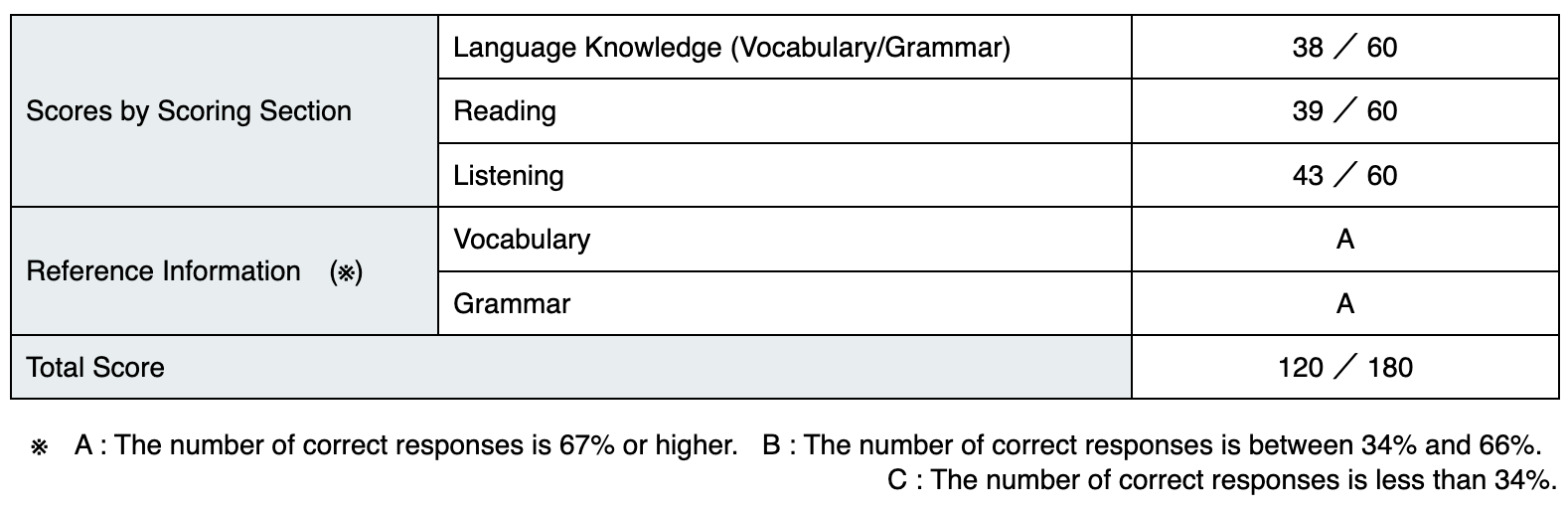
Test scores aside, I have concluded from this experience that learning Japanese by combining a structured, textbook approach and an immersive approach works best for me.
The challenge is finding an optimal balance between these two approaches.
Purely using a textbook or going to a Japanese language cram school can be very mundane, impacting motivational levels. I'd argue that motivation is more important to achieving success than the methods one employs.
To give you an example, if you told me my long-term visa approval depends solely on my Japanese capabilities, I'd study very hard every day. In some countries, like Switzerland, passing a German language proficiency exam is a pre-requisite to a long-term visa.
On the other hand, a purely immersive approach, such as watching Japanese content and trying to converse in Japanese, can be frustrating if you don't understand what is being said, read or watched. This is where the learnings from a Japanese textbook help fill the gaps.
Having completed three levels of the JLPT, I find that I am now at a tipping point where I know enough to progress quicker, with a little less struggle. The next steps are to quickly leverage these foundations to acquire more Japanese language skills. This has motivated me to aim to do the JLPT N2 next year.
My Japanese teachers have pointed out that higher levels of the JLPT introduce grammatical terms and vocabulary seldom used in daily conversation. Come to think about it, this applies to English too - we don't regularly use complicated English terms on a day-to-day basic.
My first impressions learning the JLPT N2 material is there is a big, non-linear jump in difficulty (from the JLPT N3). This explains my decision not to do the test in December this year.
Many grammatical terms have similar meanings, yet express different emotions and context to the listener. And some formal terms are to be applied in non-conversational situations only. You will be misunderstood if you do otherwise.
Given the volume of new material to learn, rote memorisation will only take me so far. I hate to admit this, but the old-school learning methods from Chinese school, which I have avoided as much as I can, may very well be the path to success from here on.
Diligently writing new kanji (Japanese: 漢字, English: Japanese characters with Chinese origins) characters by hand. Learning how to apply new grammar and vocabulary by constructing sentences. And building a consistent reading habit.
I don't look forward to these challenges. But if there's one thing I am thankful for, I can tackle them without the threat of the school cane.
--Ends