WB065: The Cost of Digitalisation

The other day, I learned something very interesting about Japan's bank notes in the reading class I participate in.
To recap, every two weeks we discuss a short story from author Shinichi Hoshi's (Japanese: 新一星) book called "Bokko-chan" (Japanese: ボッコちゃん). The book is a collection of fictional short stories that often end with a twist.
That day, we were discussing the story of the week, titled yami no me (Japanese: 闇の目). The title's literal translation is "The Eyes of Darkness".
The story is about a young boy who lives with his mother and father in a home deep in the woods, far away from the bright lights of the city. We gather from the story that the home is enveloped in darkness all the time, even though the house has electricity and lights.
Over the course of the story, we learn the boy has special abilities: he can see clearly in the darkness and is also telepathic.
They boy's parents are anxious about his abilities, namely how society will view and accept him. Yet, they have no way of hiding their anxiety behind the smiles they put on in the darkness.
As to why they are anxious about his abilities, which sound pretty cool, you need to read the twist at the end of the story to find out.
Anyway, this topic of being able to "see" in the darkness prompted one of the teachers to share how Japan's newer bank notes are designed to help visually-impaired people. According to Japan's National Printing Bureau:
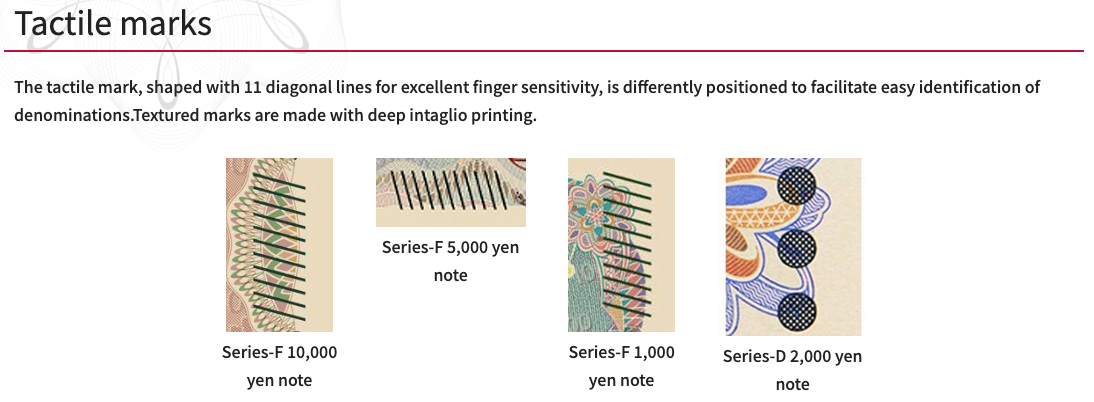
"Three Series-F notes issued on July 3, 2024 (Reiwa 6), and the Series-D 2,000 yen note issued on July 19, 2000 (Heisei 12), were printed with Braille marks and textured markings using intaglio printing with greater amounts of ink for visually impaired people. Furthermore, tactile marks for the Series-F banknotes are standardized with 11 diagonal lines for excellent finger sensitivity, with their positions varying for each denomination to make them easier to distinguish."
Visually, the tactile marks look like the snapshot below.
Do check out this feature for yourself. Everyone in the class instinctively did so, driven by curiosity over this new discovery.
This new discovery in particular got me thinking about the important, yet overlooked educational role physical currency has in society as the world moves towards digital payments.
Growing up, exchanging the pocket money I carried each day for food at the school canteen taught me what I could and could not afford.
This tangible experience, repeated daily, made me learn the value of a ringgit. I was mindful never to order more than I could at the economy rice stall, as it would be embarrassing being caught short of money.
I later learned to tell the canteen staff how much money I had for my economy rice, to which they'd serve the appropriate portions.
Understanding the value of money also made me very conscious about the safety of the money I held in my pocket. It was not much money, but without it, there was no way to buy food at the canteen. And without food, you'd have to tough it out till you reach home late in the day.
Sad to say, children growing up in a digital-first world will miss out on the important life lessons that come with handling physical money.
The mindfulness you develop from ensuring your money is safe and sound, and the value you place on money itself. When paying for an expensive meal or item, it is a far more jarring experience feeling your wallet get lighter than it is paying using a credit card or an e-wallet.
We often think that the conveniences brought about by advancements in technology make our lives better and more efficient.
Businesses don't have to worry about losing cash from the register and depositing money at the end of the day. For the tax office, analysing digital transaction data to plug tax leakages is made far easier.
The number of benefits that come from digitalisation far outweigh the costs, but the longer-term cost of digitalisation is something to always be aware and mindful about.
--Ends