WB067: Homer's The Odyssey
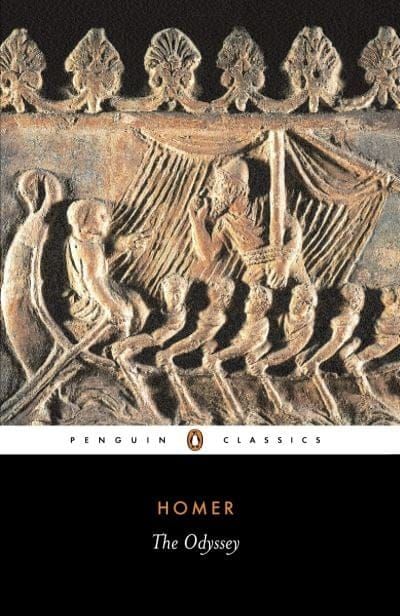
The English word "odyssey" means "a long wandering or voyage marked by many changes of fortune", according to the Merriam-Webster dictionary.
The source of the word is The Odyssey, a 24-volume collection of poems written by a Greek poet called Homer. This book of poems recounts Odysseus' 10-year journey back to his kingdom Ithaca after the Trojan War - the very war that gave rise to the well-known term "Trojan Horse".
From the day Odysseus left Ithaca for Troy to the day he returned after the war, he had been away for a total of 20 years. An epic journey indeed.
The Odyssey is one of the oldest and most significant Classics, alongside Homer's The Illiad, which is set toward the end of the Trojan War.
I stumbled across The Odyssey one day while randomly browsing the English section in the Chiyoda Public Library.
I initially had serious reservations over borrowing this book, as to me the Classics are dry, boring and difficult to read. In high school, I remember being quite impressed by one of my classmates who was extremely skilled and interested in the Classics,.
Putting these reservations aside, I proceeded to borrow the book as I had never read a Classics book and was curious what it had to offer. And given the only cost to borrowing a book from the library is the commute time and train ticket, why not?
The book I borrowed is a revised version of Emile Victor Rieu ("EVR")'s translation (from original Homeric Greek to modern English) published by Penguin Classics in 1945.
EVR's son, Dominic Christopher Henry Rieu ("DCHR"), was incidentally the author who did the revision, published in 1991.
Both father and son studied Classics in university, a course that I've always wondered so much about. There are actually many modern translations of Homer's books done by different authors, who I would think have also studied Classics in university.
Surprisingly, The Odyssey was a great read that I finished within the two week borrowing period.
It wasn't nail-biting nor engrossing per se with a twist at the end. It was just refreshing for once to read content outside of my usual comfort zone (finance, biographies and some fiction) and step into the world of ancient Greece and Greek mythology.
Homer also has a distinct writing style. For example, he repeats many phrases - called epithets - that give the same description of scenes and people despite different timelines. Almost formulaic, one might say.
For example, to describe the crack of dawn, Homer often uses the phrase "rosey-fingered Dawn". And to describe Odysseus' wife, Penelope, Homer refers to her as "wise Penelope" while referring to Odysseus as "resourceful Odysseus".
Though this Homeric style is strange at first glance, I found it quite useful in helping me visualise the scene or characteristics of the cast when they are mentioned in different parts of the book.
Speaking of the cast, there are many of them in this epic poem, from Greek gods such as Zeus (chief god), Athene (goddess of wisdom and warfare) and Poseidon (god of sea) to the many mortals Odysseus comes across in his odyssey.
It is understandably very easy to forget who is who, especially when you read the book over a period of time. This issue is alleviated somewhat as Homer makes it a point to add each character's familial relationship to their name.
For example, "Telemachus, son of Odyssseus" or "Odysseus, son of Laertes". This formulaic style means the reader doesn't need to flick back and forth as often to find out who is who.
While reading The Odyssey, I realised I have a habit of skim reading, in addition to my mind wandering to other thoughts. As a result, I found myself missing out important details and developments.
The solution: consciously focusing on reading line-by-line.
I think these bad habits have developed over time from trying to consume as much content as possible in the shortest period of time. This habit is probably why I don't retain as much information as I used to, a skill I hope to regain over time.
--Ends