WB068: Connecting the kanji dots
The Japanese language is made up of three writing systems: hiragana, katakana and kanji.
Most Japanese sentences comprise characters from all three systems. So to be proficient, you have to learn all three systems.
You could of course decide to only learn to speak Japanese by watching and listening to lots of Japanese content. Or learning one or two of the three writing systems. However, at some point I think you will end up handicapping yourself.
Of the three writing systems, kanji is probably the one that people have most difficulty with, me included.
Kanji is a system of Japanese characters adopted from Chinese characters. This explains why native Chinese speakers have an easier time learning kanji, as the meaning is more or less the same (to the Chinese character).
日本 - pronounced nihon - for example, is the Japanese word for "Japan". In Chinese, 日本 is pronounced ri4 ben3.
日 comes from the Chinese character for "sun" while 本 means "origin". A literal translation of 日本 is "origin of the sun", which I think gives rise to "Japan" meaning "land of the rising sun".
Kanji itself has two categories of pronunciation: kun-yomi (Japanese: 訓読み) and on-yomi (Japanese: 音読み). The former is the native Japanese pronunciation of a kanji character while the latter is borrowed from the Chinese pronunciation.
Knowing both kun-yomi and on-yumi are important, as they are used interchangeably depending on the vocabulary.
In preparation for next year's N2-level Japanese Language Proficiency Test, I have been dedicating more time to learning kanji than I did in previous levels.
Given the complexities associated with kanji, my learning journey so far has been challenging. It would be far quicker if I could remember things easily by rote, but this is unfortunately not the case.
I am instead finding it more effective to start with building an understanding of the kanji character I am learning, then tying this understanding to Chinese and Japanese words I am already familiar with.
Case in point, I recently came across the character 幾, whose on-yomi is ki and kun-yomi is "iku".
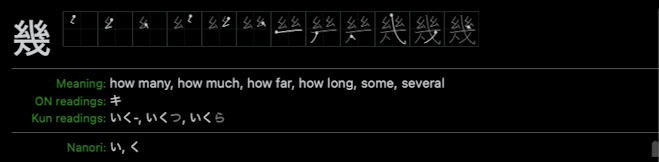
I initially had a hard time memorising the pronunciation and meaning of this word. There didn't seem to be anything to anchor this memory to.
Things finally clicked when I discovered the simplified Chinese equivalent of 幾 is the familiar 几 (ji3), meaning "how many" or "how much". This meaning is also the same for 幾.
I then learned that 幾 is part of the commonly-used Japanese word ikura (Japanese: 幾ら), meaning "how many" or "how much".
Despite knowing what "ikura" meant, this link was initially unclear to me as the ikura is commonly written in its hiragana form, いくら. As there are no hard and fast rules when one uses hiragana or kanji, knowing both systems is crucial.
Taking things a step further, adding the Chinese character radical for wood, i.e. 木, to 幾 gives you the character 機. This is a character I already recognise from the Japanese word kikai (Japanese: 機会, English: opportunity).
In simplified Chinese, 機会 is written as 机会 (ji1 hui4), also a familiar Chinese word.
It's strange. Sometimes when I see a character in isolation, its pronunciation escapes me. But when the character is seen in the context of a familiar vocabulary, it all makes sense.
As a result, I find it important to draw links between kanji characters and previously-learned words. This may be time consuming, but it is well worth the effort.
--Ends