WB076: The Race To Adapt To The Age of AI
Not a day goes by without a news article, YouTube video or passing remark about the tremendous advancements in Artificial Intelligence (AI) technology and how it is quickly reshaping our world.
The internet is always abuzz with bold predictions when there are new iterations of popular AI applications like OpenAI's ChatGPT and Anthropic's Claude AI. These predictions are usually about which jobs will be displaced by AI.
I think there is definitely some basis to what is being predicted. That said, it doesn't cost a cent to make a prediction, and things given for free should always be viewed with a healthy level of skepticism.
Industries ripe for disruption
What is clear is that white collar industries are most at risk, some more than others. One industry that comes to mind is the Business Process Outsourcing (BPO) industry.
BPO companies provide customer and human resource services to large companies that prefer to outsource these non-core operations that are considered "cost centres".
A lot of the world's BPO workforce comes from India and the Philippines, as their labour workforce has high English language proficiency, making them ideal partners to large Western multinationals.
For the longest time, BPO companies have had a very profitable business model. They charged developed-market rates yet hired lowly-paid workers from developing countries. BPO companies have also been quite resilient to disruption by machines as the human touch is essential.
This long-standing moat is now being challenged by AI chatbots that can communicate like a human, efficiently analyse large amounts of data and work in multiple languages. All at the fraction of the cost of a real human employee.
The Educational Technology ("EduTech") industry is also facing AI-driven headwinds. AI chatbots, with their "ask and answer"-style user experience, can now act as on-demand tutors that are probably more effective than existing EduTech apps like Duolingo.
I now use ChatGPT to look up the meanings of words, correct my sentences and also suggest better ways to memorise difficult vocabulary.
Labour is typically the largest cost in white-collar companies, which are now training their guns on roles that can be replaced by AI. Recently, Block laid off 4,000 of its 10,000 employees while Atlassian cut 10% of its workforce.
Large-scale job cuts are alarming and indicate that there are many middle- and back-office roles that can now be managed by fewer employees with the help of AI.
Survival of the most adaptable
These days, it must be nerve-wracking to be a fresh university graduate about to enter the workforce for the first time. Or a university student studying to be a software developer or aiming for a career in Finance.
With AI seemingly able to replace many white-collar roles, one can't help but wonder, 'What is the point of my university degree?'.
Mid-career workers are also in the firing line, as they now find skillsets honed over the years seemingly rendered obsolete overnight. Think highly-paid workers in Management Consulting and Investment Banking who, I feel, were way overpaid to begin with.
There have been countless instances throughout human history where technological advancements brought about large changes to the way we live.
The Industrial Revolution in the late 1700's transformed agrarian economies to manufacturing economies. The combination of high-speed internet and smart phones transformed how we work and communicate with one another.
Humans are designed to respond to the right motivators, as stated in Maslow's Hierarchy of Needs. An effective, though daunting, motivator that is being brought about by AI is the threat of many a rice bowl being taken away.
While the future looks bleak, there is always a silver lining. So long as you keep an open mind and put in the elbow grease to learn how to leverage these AI tools, you will not be left behind.
It is equally important not to use AI tools to take shortcuts so that you can spend more time watching YouTube or playing computer games. Time saved should be spent on activities that develop you as a human being.
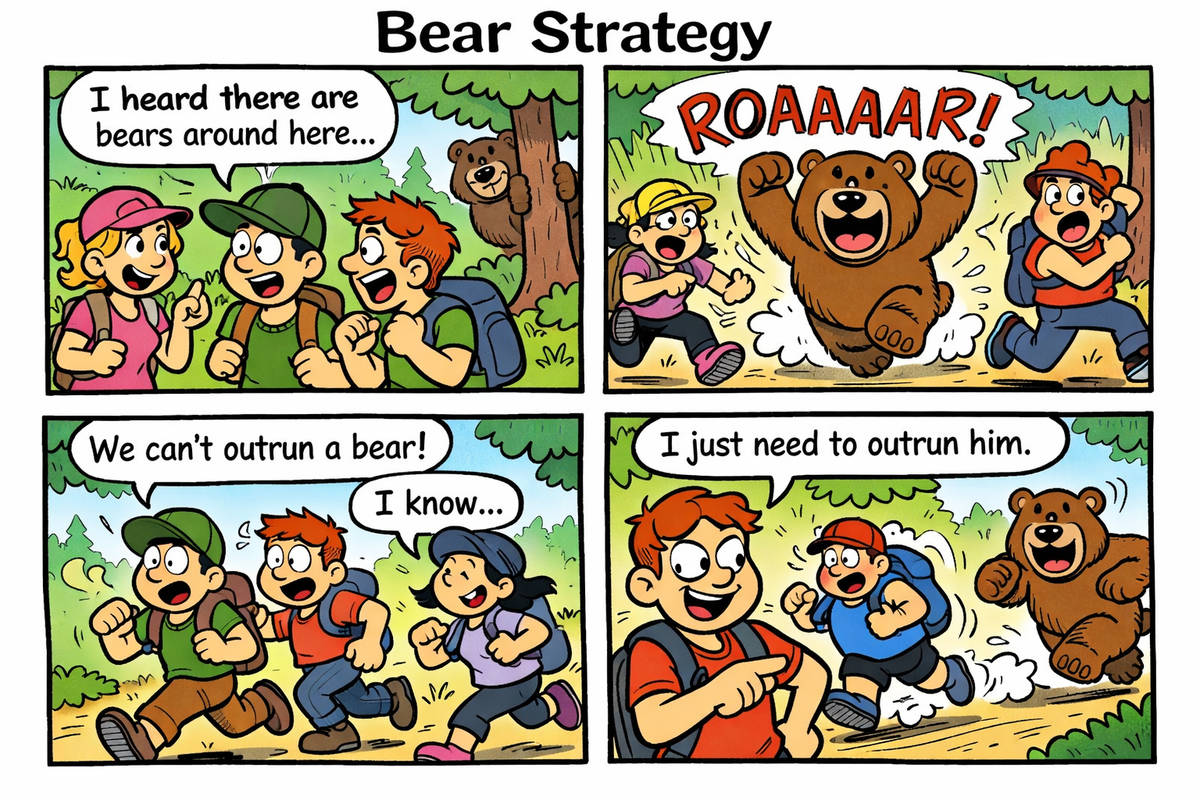
When in a group chased by a bear, you don't need to run the fastest to survive. You just need to make sure there is one person slower than you.
--Ends